The Lord hath promised nothing to idle bellies: what James Pilkington meant
The line on the shirt is half a sentence. James Pilkington wrote the other half in the same breath, and it is a promise: "unto him that laboureth to serve his God faithfully, he hath promised his sure aid, and will surely perform it." The sentence sits in a commentary on the book of Nehemiah that Pilkington did not live to finish. His friend John Foxe, the man who wrote the Book of Martyrs, saw it through the press in 1585. The whole book is sharper than one line suggests, and the sharpest part is aimed at his own side.
The wall
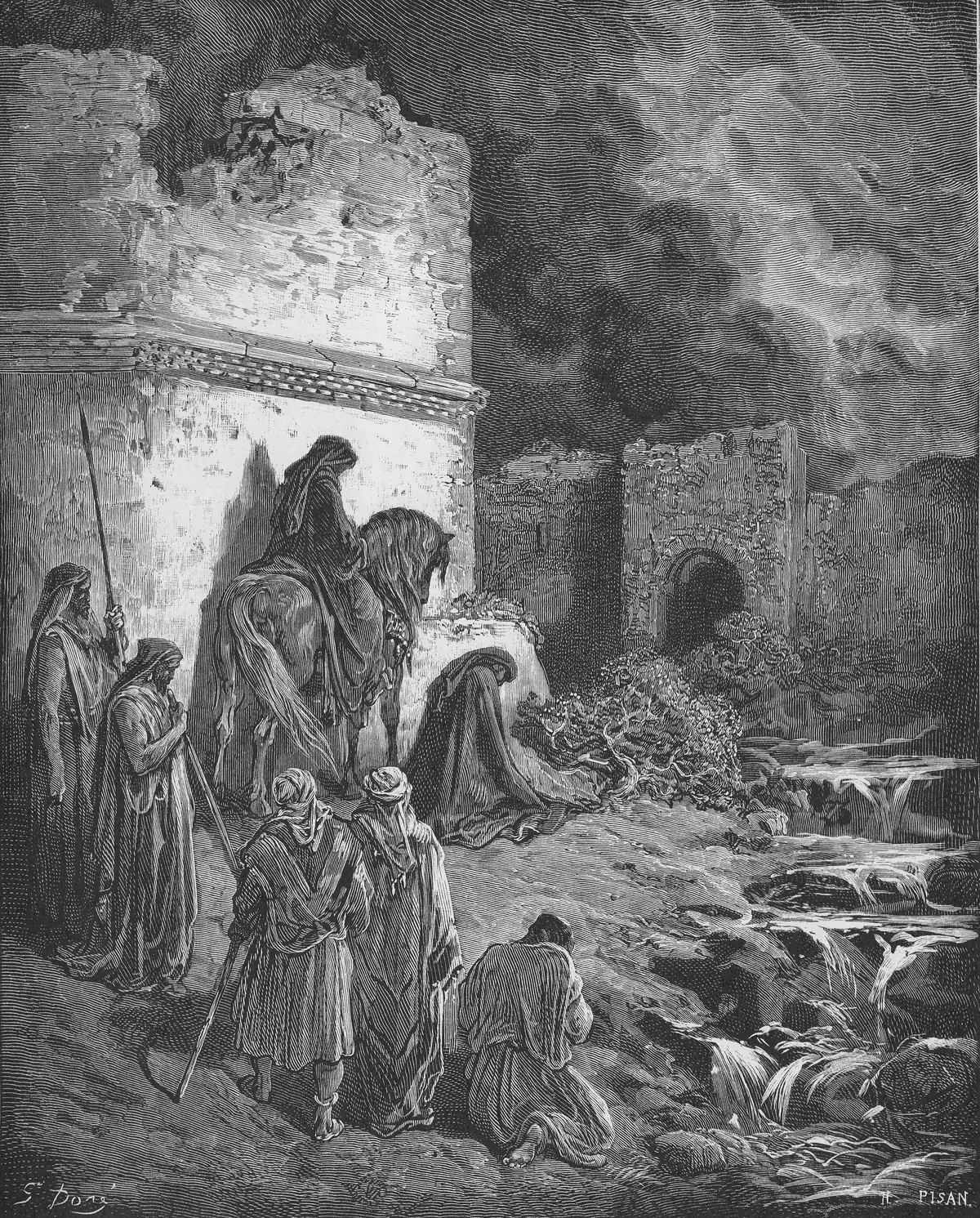
The book of Nehemiah tells how a Jewish official at the Persian court got leave to go home and rebuild the broken wall of Jerusalem. The neighbours did not want the wall built. By chapter four the builders were working armed. "The laborers who carried materials worked with one hand and held a weapon with the other" (Nehemiah 4:17). Nehemiah kept a trumpeter beside him and told the people that wherever they heard the horn they should rally to it, because their God would fight for them.
Pilkington stopped on that promise. God would fight for them, and Nehemiah still walked the wall every night. In Pilkington's words, he "ceaseth not to keep watch and ward night and day, to search the watch himself, to teach the soldiers how to use their weapon, to set them in array, to encourage them, to teach them to understand what the trumpet meaneth." The promise sent no one to bed.
The axe
That is where the sentence comes from. Pilkington draws the lesson out of chapter four in a paragraph that starts with God and ends with the belly. "Although God do work all things himself," he writes, "yet he worketh them not without us: we must not be idle." Then he reaches for a picture from a workshop.
"We be as an axe in the carpenter's hand, where the axe may not claim the praise of well-doing from his master that worketh with it: and though the axe be a dead instrument without life or feeling, and man hath life, wit, and reason given him to do things withal; yet is man as unable to work his own salvation without the free mercy and special grace of God, as the axe is unable to build the house without the direction and ruling of the carpenter."
An axe does nothing on its own. It also does nothing lying on the bench. Pilkington had used the same picture earlier in the commentary, and here he backs it with a line he credits to Bernard: you are created, healed, and saved, and which of these did you do yourself? Then comes the sentence the shirt is cut from, whole.
"Let every man be diligent, and a painful labourer in his vocation, and work his own salvation as far as an instrument may, not loitering nor living unprofitably, thinking that God will bring such things to pass if we lie down and sleep; but the chief praise and effect must be given in all good things to God alone. The Lord hath promised nothing to idle bellies; and unto him that laboureth to serve his God faithfully, he hath promised his sure aid, and will surely perform it."
Painful meant painstaking in his English, not hurting. "As far as an instrument may" is the axe again. And the belly was not a casual word. In his other writing "idle belly-gods" is Pilkington's standing name for monks and for the pope's chaplains, men he believed were paid to eat. He presses on: Adam in paradise "was not suffered to be idle, even in his innocency," so what business had sinners living "as we list at our ease"?
The clock and the alehouse
A page later he turns from Jerusalem to England, and it is the liveliest writing in the book. Nehemiah's men worked "from the day spring unto the late in the evening, that the stars did rise." Pilkington calls that "a rare example to be found at this day" and describes the English labourer he knew. He "will take his rest long in the morning." He wants his breakfast at the usual hour "though he have not earned it." When the clock strikes he drops his load in the middle of the road. He sleeps at noon, takes his afternoon drink, and at the first stroke of the evening bell "casteth down his tools, leaveth his work, in what need or case soever the work standeth." The soldier on the wall is no better. It is cold up there, so he is off to the alehouse.
The monasteries had been shut for more than thirty years when he wrote this, and he could not resist the joke. "Though abbeys be gone, yet the abbey-lubbers, which will work until they be cold, eat until their belly ache, and sleep until their bones ache, are too common in every house." The next line gives the joke its edge. A lazy day "is thought with many no sin, but a pastime; and yet is it thievery to take the day's wages, and do not a good day's work for it."
He does not leave it with the servant. He had seen the graffiti that servants and masters wrote against each other on the same wall. The servant scratched Fidelis servus perpetuus asinus, a faithful servant is a perpetual donkey. The master wrote back, "Deserve, and then desire." Pilkington's verdict is that "both being to blame, both procure God's anger towards them." The man who steals the day and the man who will not pay for it share one paragraph. In the next chapter the masters get the longer treatment.
Chapter five
Nehemiah 5 opens with the builders' families crying out. They had mortgaged their fields to eat and to pay the king's tax, and the lenders were their own people. "We are subjecting our sons and daughters to slavery," they say. "Some of our daughters are already enslaved, but we are powerless to redeem them because our fields and vineyards belong to others" (Nehemiah 5:5). Nehemiah calls the nobles together and tells them that what they are doing is not right.
Pilkington gives the poor a long speech in his own words. "Their bellies cleave to the very back for hunger, and so do ours." It is the same word from the other end. The idle bellies of chapter four were men who would not work. The empty bellies of chapter five belonged to men who had worked on the wall and been stripped by the people they built it for.
Then he says who he means, and it is not Rome. "There was never greater cruelty, oppression of the poor, hypocrisy and dissembling in God's cause, and unmercifulness amongst men in this land, than hath been since the beginning of the reforming of religion amongst us; yea, and that is more wonderful, of such as would pretend to be favourers of religion." The favourers of religion were the Protestant party, which was his own.
He lists what they had done, and it reads like a charge sheet. Men had begged or bought land from the crown, which in those years was selling off what it had taken from the monasteries. They set about "selling the woods, surveying the land to the uttermost acre," and "enhancing of rents to the highest, from twenty pounds to an hundred." They racked tenants "by intolerable fines" every five or seven years and made them cart the landlord's goods, "paying never a penny for their labour, ride and run when he is commanded." Others pulled down villages to turn plough land into sheep pasture and "set a shepherd and his dog where so many have dwelt," so "that a poor man may not dwell so near a man of worship."
He spells out one trick in detail. A landlord demands an entry fine from a tenant who has no money. He values the man's few sheep, sets the fine from that valuation, then lets the man keep his own sheep on condition he pays a yearly rent for them. The tenant is now paying interest to use his own animals, "and this dealing is thought great courtesy." Pilkington adds that he hesitated to describe it, in case some reader learned the method.
He knew the risk in writing this way. Hugh Latimer had preached against the same rent-raising under Edward VI, "not without blame," Pilkington notes, "as peradventure this will be too." He did it anyway, and gave his reason from the book of James: the wages held back from the men who reaped the fields cry out to the Lord of hosts. Tenants, he writes, are "children of the same God, and bought by the same price that their masters be." As Bishop of Durham he was himself a great landlord. He was writing about his own class and his own church.
The book he did not finish
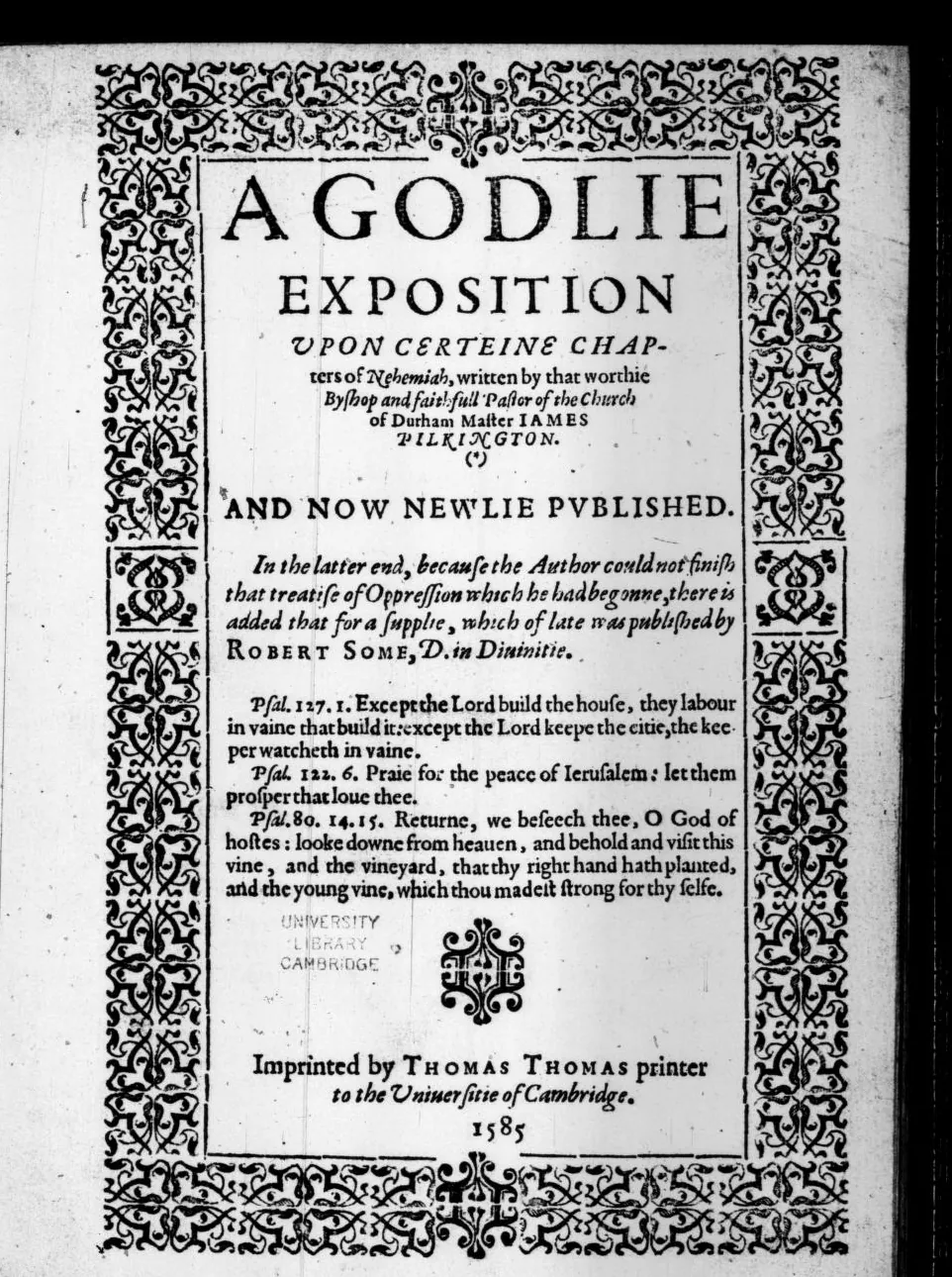
He was still inside that argument when he died, at Bishop Auckland on January 23, 1576. The commentary breaks off in chapter five of a thirteen-chapter book, on the subject of oppression. John Foxe had shared his exile under Mary I, and Pilkington had given him a stall in Durham Cathedral in 1572. Foxe took the manuscript to Cambridge, where Pilkington had once been Master of St John's College. Thomas Thomas, the first man appointed printer to the university, two years into the job, printed it in 1585 with a preface by Foxe.
The title page is candid about the gap. "Because the Author could not finish that treatise of Oppression which he had begonne," it says, a short tract by Robert Some was added at the end to fill it. Foxe's preface says the work "is left unperfect, onelie containing fiue Chapters by him expounded." Nine years after his death, the last of James Pilkington's books to reach print was a half-finished case against the landlords of his own party, with another man's pamphlet bound on where his own argument stopped.
The picture
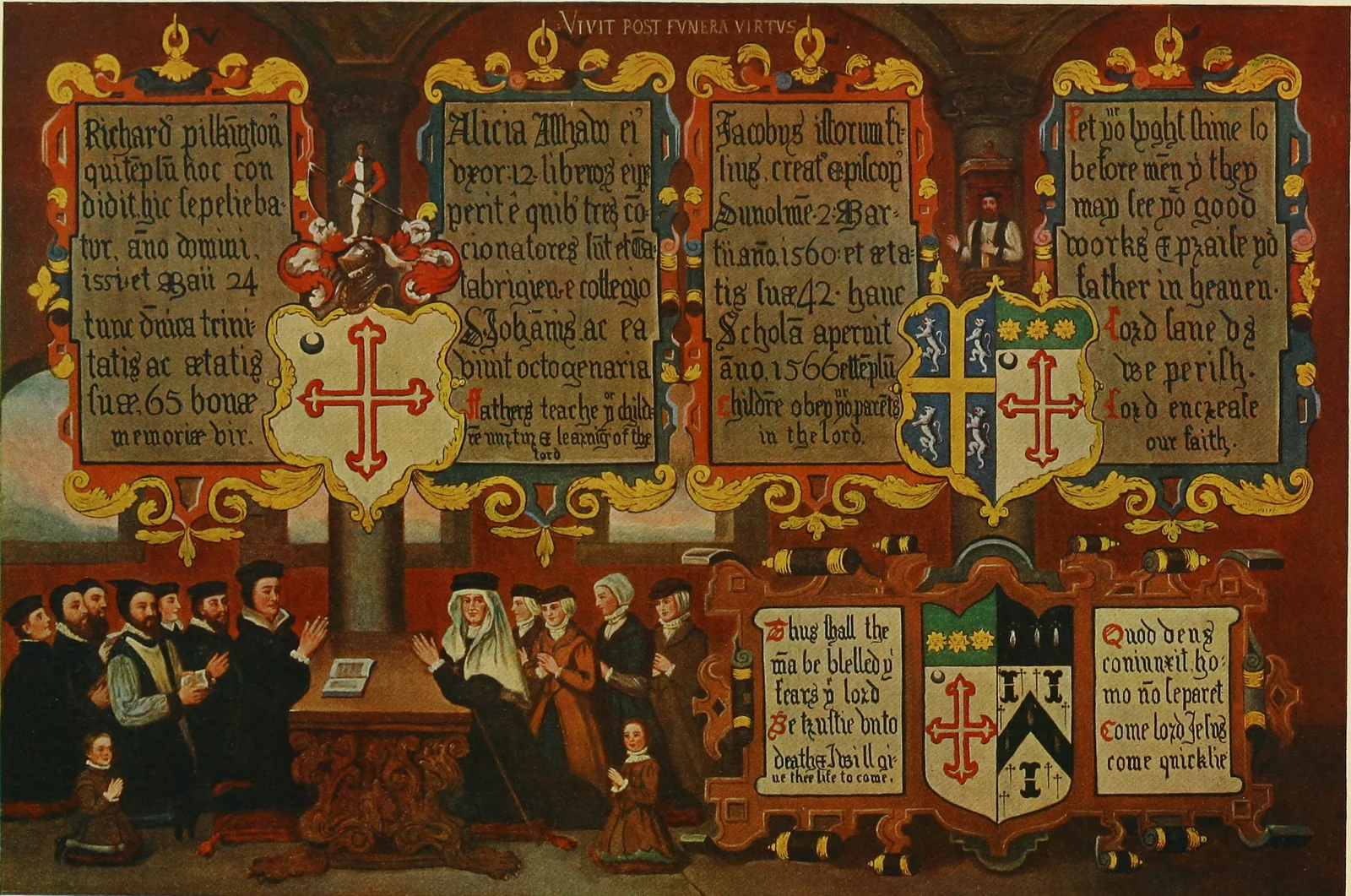
The painting at the top of this page is the only known portrait of him, and he ordered it himself. In 1566, the year he opened his free grammar school at Rivington, he had this memorial painted for the church his father had founded there. The Latin tablets record his father Richard, buried in May 1551, his mother Alice, who bore twelve children and was still living past eighty, and James, made Bishop of Durham on March 2 in 1560 by the calendar of the day and 1561 by ours, aged 42, who "opened this school" in 1566. Three of the sons became preachers. The English tablets are instructions. Fathers, teach your children virtue and learning of the Lord. Children, obey your parents in the Lord. Fourteen figures kneel below, the bishop among his brothers in a white surplice and square cap with a book in his hands.
The picture was scorched in a fire at the church in 1834, when someone set light to a pile of benches during a cleaning. A copy made in 1823 saved the design, and a copy taken from it hangs in the church today. Vivit post funera virtus, says the line across the top. Virtue lives after death.
The shirt

Our James Pilkington tee prints the first half of his sentence over a deadlift. The lift is a modern picture of what he asked for, a painful labourer in his vocation, and not a scene from his life. The words are his, from the commentary on Nehemiah 4. The second half of the sentence, the promise, is what he meant them to lead to. Nehemiah 4:14 is on the sleeve.