Ink against fire: how the press that printed indulgences carried Luther
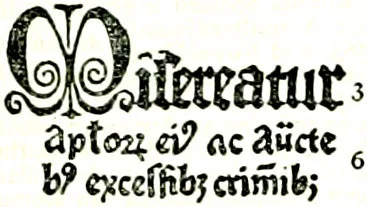
The oldest dated piece of printing in Europe is not a Bible. It is a receipt for a pardon. In 1454 a papal commissioner named Paulinus Chappe was raising money in Germany for the defence of Cyprus against the Turks, and he needed letters of indulgence faster than scribes could write them. He contracted with the new press at Mainz, the shop of Johann Gutenberg, which was then finishing its Bible. The form it produced runs to thirty-one lines of type and leaves blanks for the buyer's name, the place, and the day, to be filled in by hand. Forty-six copies survive. The earliest date written into one of them is October 22, 1454.
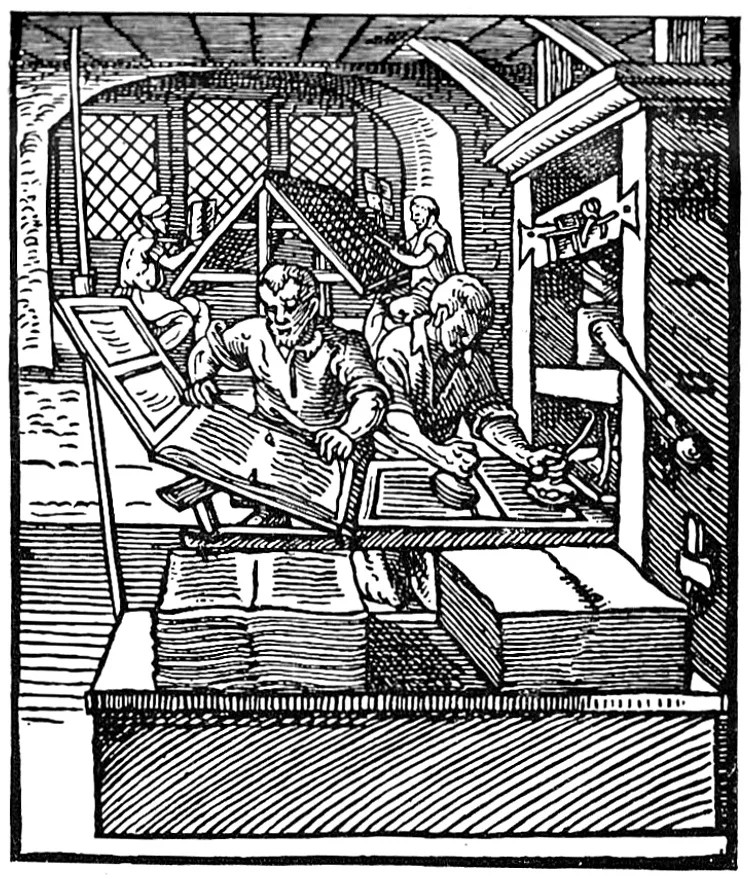
Sixty-three years later, forms of the same kind were in the chests Johann Tetzel carried through Saxony. What Tetzel sold and what Luther answered are told on our Reformation collection page. This page is about the machine. It printed the pardon, then it printed the argument against the pardon, and then it did something the church had not planned for: it made the argument impossible to burn.
A Latin notice
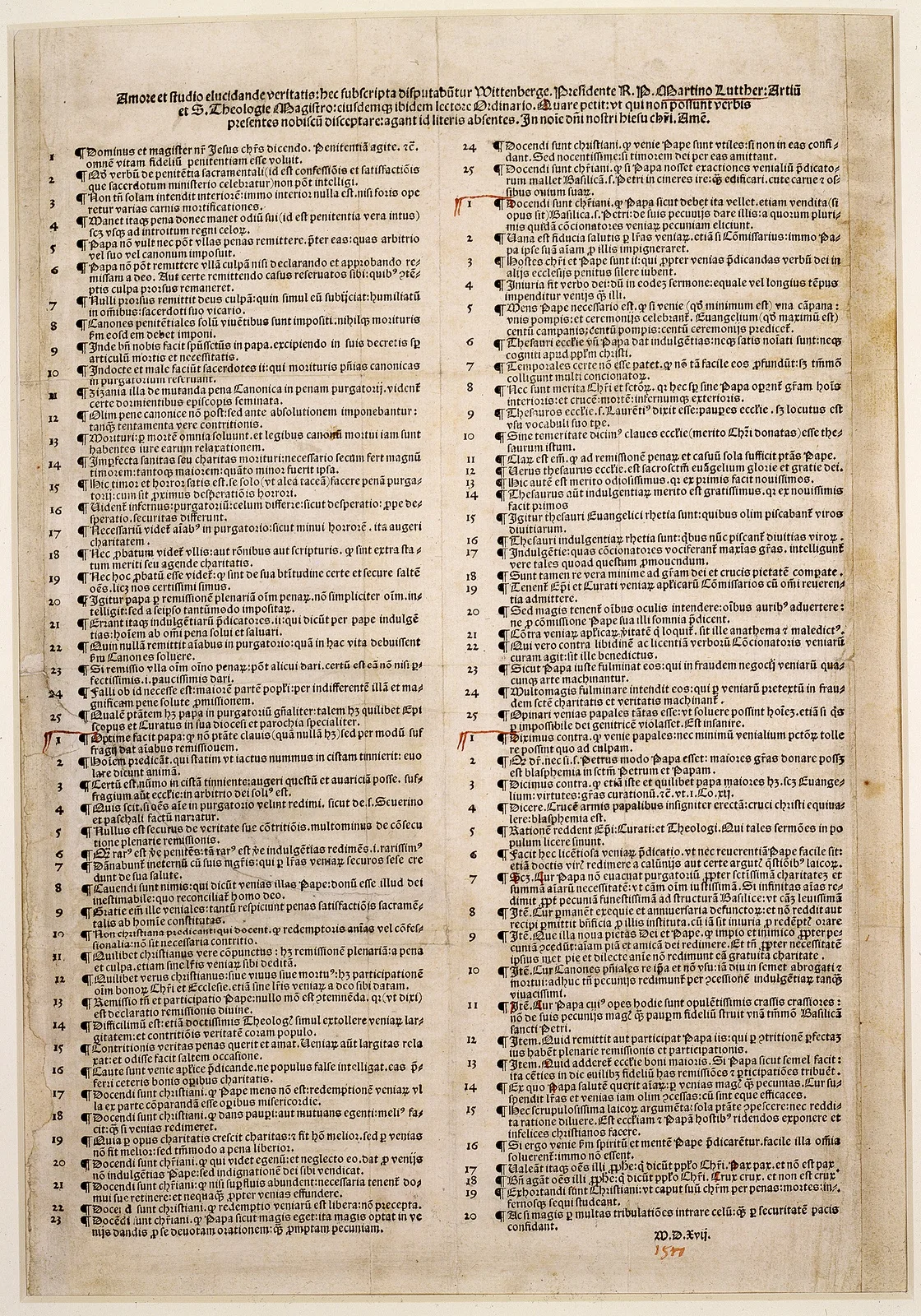
The Ninety-Five Theses were not written for the public. They are a notice of an academic disputation, in Latin, addressed to scholars, and no record survives of the disputation ever taking place. Even the door is uncertain. The story that Luther nailed the theses to the Castle Church comes from Philip Melanchthon, who wrote it down after Luther's death and had not yet arrived in Wittenberg in 1517. A note by Luther's secretary Georg Rörer, found in 2006, says the theses were posted on the doors of the town's churches, but Rörer came to Wittenberg five years after the event. Luther himself always said he went through channels. What is documented is his letter to Albrecht, Archbishop of Mainz, the man licensing Tetzel's sale, dated October 31, 1517, with the theses enclosed.
Then the copying began, and none of it happened in Wittenberg. Before the year was out the Latin theses had been printed as a single broadsheet in Nuremberg by Hieronymus Höltzel, as a broadsheet in Leipzig, and as a four-page pamphlet in Basel. A few hundred copies in all, for a learned readership. In Nuremberg a city councillor, Kaspar Nützel, translated them into German. Luther's friend Friedrich Myconius, writing a generation later in a history meant to celebrate, said hardly fourteen days had passed before the theses were known throughout Germany. He was working from memory. But the Nuremberg broadsheet exists, in the Berlin State Library, and it is dated 1517.
A handful of pages in German
What reached ordinary people was not the theses. In March 1518 Luther published a short sermon in German, Ein Sermon von Ablass und Gnade, on indulgences and grace. It runs to a handful of pages. It was reprinted at least two dozen times in the next three years across Germany and Switzerland. It was the first thing Luther wrote that people who were not theologians bought, and it was the point at which he stopped writing for the faculty.
The form mattered as much as the language. The German pamphlet of those years, the Flugschrift, was a sheet or two of paper folded into quarto and sold unbound, with a title page and often a woodcut border. Mark Edwards, the historian who counted them, puts the price of an average pamphlet at about a third of a day's wage for a journeyman craftsman. A book was a purchase. A pamphlet was something you picked up at a stall. Lucas Cranach, the court painter who lived a few streets from Luther, designed the title-page frames, so that a Wittenberg print could be recognised across a market.
The numbers are Edwards's. In 1518 the presses produced 87 printings of works by Luther, 41 of them in German. In 1520 they produced 275, and 235 of those were German. Between 1518 and 1525 there were about 1,600 printings of Luther, and roughly one in every five pamphlet editions printed in Germany between 1500 and 1530 carried his name. Across the years 1518 to 1544 there were five printings of Luther for every one by a Catholic controversialist. His open letter To the Christian Nobility, in August 1520, had a first printing of four thousand copies, an enormous run for the time, and by most accounts it sold out within days.
Wittenberg had not been ready for this. In 1517 it had one printer, Johann Rhau-Grunenberg, with one slow press. In 1519 the Leipzig printer Melchior Lotter was persuaded to send his son to open a shop in Wittenberg with better type, and the shop was set up in Cranach's own house. Cranach and a goldsmith, Christian Döring, put money into the trade. By 1543 the town had six presses. A small town with no book trade to speak of had become, on the strength of one author, one of the busiest publishing centres in Germany.
Judges who came too late
The old way of settling a doctrinal argument was a disputation: Latin, in a university hall, before judges. Luther's opponents tried it once more. From June 27 to July 15, 1519, Luther, his colleague Karlstadt, and the Ingolstadt theologian Johann Eck argued in the great hall of the Pleissenburg at Leipzig, with Duke George of Saxony, no friend to Luther, in the chair. Four notaries wrote down every word. The record was to go to the universities of Erfurt and Paris, who would decide who had won. When Luther said in the hall that some of what Constance had condemned in Hus had been sound Christian teaching, the duke put his hands on his hips and said, loud enough for everyone to hear, "A plague upon it." What that admission did to Luther is told on the forerunners page.
The judges never mattered. Erfurt sent the record back without a verdict. Paris took until April 1521 and then issued a general condemnation of Luther that barely mentioned the debate. By then the printed accounts of Leipzig, Eck's, Luther's, and Melanchthon's, had been on sale for a year and a half, Luther had been excommunicated, and he was on the road to Worms. The universities had been asked to decide a question the printers had already settled.
"It is a bubble"
Rome's answer was a document. The bull Exsurge Domine, dated June 15, 1520, condemned forty-one propositions from Luther's writings, gave him sixty days to recant, and ordered his books burned. Eck was sent to publish it in Saxony. A papal nuncio, Girolamo Aleander, took it to the emperor's court in the Low Countries and the Rhine.
Eck's tour went badly. At Leipzig he had to hide in a monastery for an hour in fear for his life. At Erfurt a printer put copies of the bull up for sale, and students took them, tore them up, and threw the pieces in the river. Luther told the story himself in two letters that autumn. "It is a bull; let it float on the water," he wrote on October 30, punning on the Latin bulla, which means both a sealed document and a bubble. On November 4 he reported to his friend Spalatin that the Erfurt students had thrown the copies in one after another, saying "now it really is a bubble."
Aleander's tour went better, and his own dispatches to Rome show what it cost. At Louvain in October 1520 more than eighty of Luther's books were burned on a platform in the market, with the magistrates in their robes. Erasmus, who was living in Louvain, wrote that the effect was that everyone stood laughing. A hostile pamphlet, attributed to the reformer Oecolampadius and so not a neutral witness, claimed that students had thrown so many scholastic textbooks on the fire that more of those burned than books by Luther. At Cologne on November 12 the burning was semi-public. At Mainz the first attempt, on November 28, failed. Aleander blamed the emperor's short stay, a busy archbishop, "the perversity" of the men appointed to help him, and "the maliciousness" of the town. The next day the condemnation was announced with trumpets and the books were burned in the face of open opposition.
In the dispatch that reported this, Aleander explained why he had pressed on. Burning, he wrote, spread the news of the condemnation through Germany better than sending the bull to the bishops ever could. Read that again. The pope's agent was saying that a fire was a way of publishing. He was competing with the printers on their own terms and losing.
Luther replied in kind. On the morning of December 10, 1520, a notice in Melanchthon's hand on the church door invited the students of Wittenberg to a chapel outside the town walls at nine o'clock. There, in front of Luther, the other professors, and a crowd of students, twelve volumes went into a fire: the books of canon law, papal decrees, works of scholastic theology, and writings by Eck and Emser. Then Luther threw in a copy of the bull. A protocol written that day, probably by his colleague Johannes Agricola, gives his words, which are hard to translate and came to something like: since you have perverted the truth of God, the Lord perverts you today; into the fire. He then went home and wrote a pamphlet, in Latin and in German, explaining why he had done it. The students held a second, mock-funeral burning after lunch, with a wagon and trumpeters. Luther was not there.
The edict against ink
Worms is remembered for what Luther said. The edict that followed, dated May 8, 1521, is remembered for putting him under the ban of the empire. Less remembered is that most of its text is about paper. It forbade anyone to print, sell, buy, or own Luther's books, ordered them publicly burned, and then went further. No one was to print anything touching Holy Scripture without first getting the consent of the local authorities and the advice of a university's theology faculty. Other books needed the approval of the emperor or his officers. And the edict named pictures alongside writings, because its authors understood that a woodcut reaches a man who cannot read.
They had reason to. That same spring Cranach, working from a text by Melanchthon and the jurist Johann Schwertfeger, published the Passional Christi und Antichristi: thirteen pairs of woodcuts, contrasting scenes from the gospels with scenes of papal ceremony on the facing page. It needed no Latin, and it needed no reading.
None of this was new law. In 1515, two years before the theses, the Fifth Lateran Council had issued a decree, Inter sollicitudines, requiring a bishop's approval before any book was printed anywhere in the church. It was in force when Höltzel set the theses in Nuremberg. Nobody asked him for a licence. The Edict of Worms had the same problem in a sharper form. In Electoral Saxony, where Luther lived, Frederick the Wise never enforced it. He had Luther hidden in a castle.
Three thousand copies with no name on them
What Luther did in that castle is on the Martin Luther product page: the New Testament translated into German in eleven weeks. What happened to the manuscript is the end of this story.
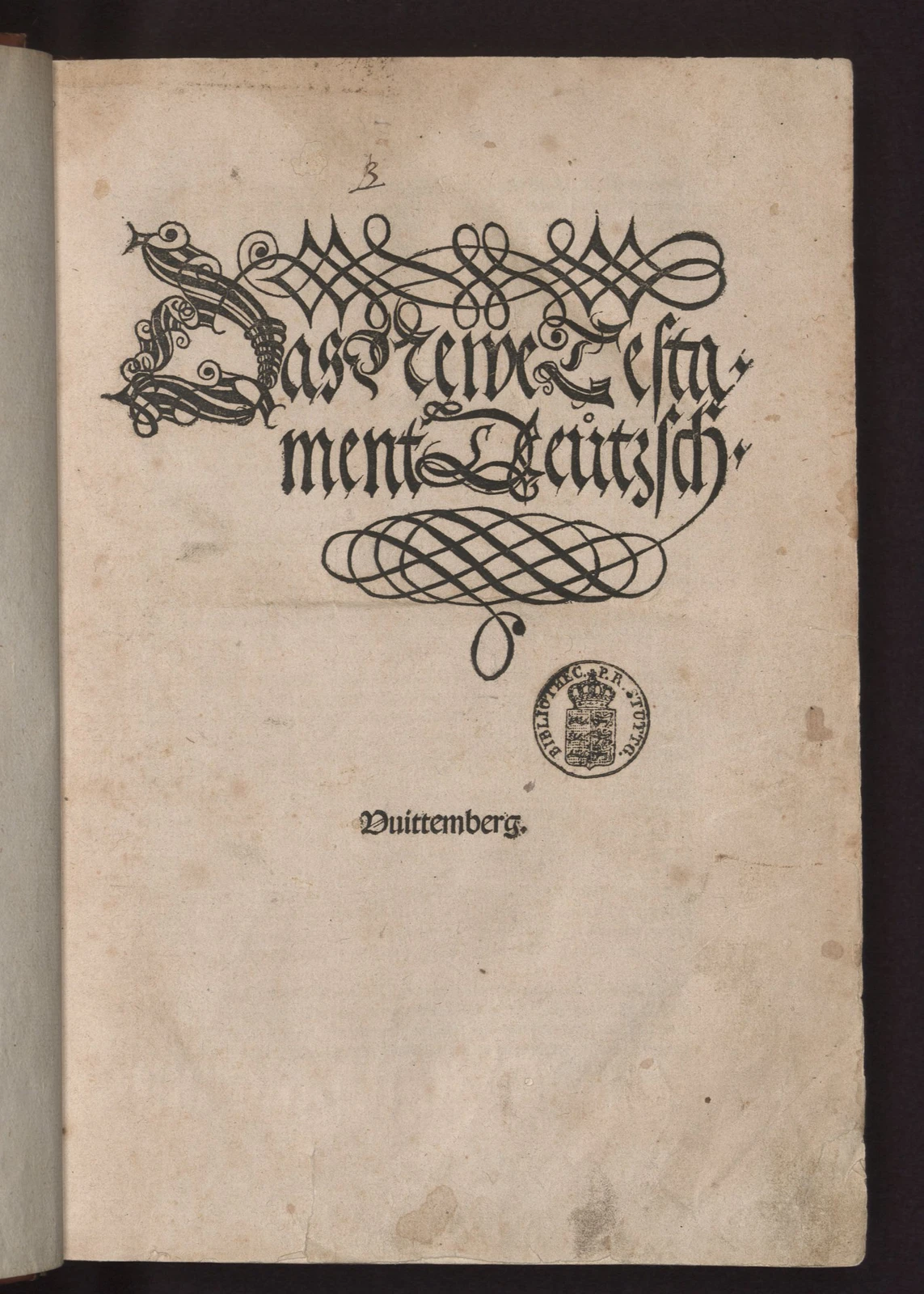
Back in Wittenberg in March 1522, Luther and Melanchthon revised it, and Melchior Lotter the Younger put three presses on it in Cranach's yard. The publishing risk was carried, most historians think, by Cranach and Döring. Around three thousand copies were printed for the Frankfurt autumn fair, an unheard-of run for a book that size. The title page reads "Das Newe Testament Deutzsch. Vuittemberg." It names no translator, no printer, and no year. Everyone in Germany knew whose it was. Cranach's workshop supplied twenty-one full-page woodcuts for Revelation, and in two of them the beast from the abyss and the woman of Babylon wear the three-tiered papal crown. A copy cost around a gulden, more with a binding, which for a schoolmaster was something like two months' pay. It sold out within weeks. A second printing, the December Testament, followed, and in that printing the papal crowns had been cut out of the blocks, leaving white space where they had been.
Duke George banned the book in his half of Saxony six weeks after it appeared and offered a refund to anyone who handed in a copy. Brandenburg, Bavaria, and Austria followed with bans of their own. None of it slowed the presses. By 1533 Luther's New Testament had been printed eighty-five times. Duke George's own answer was to commission a Catholic version from Hieronymus Emser, which came out in 1527. Luther read it and wrote, in 1530, that Emser "took my New Testament nearly word for word as it was written, and removed my prefaces and notes, replaced them with his own, and thus published my New Testament under his name." The duke had forbidden Luther's translation and ordered his subjects to read it under another man's name.
What burning could not do
For a hundred years the church's remedy for a heretic had two parts, and the forerunners page tells both: the man went to the fire, and his books and his ashes went into the river. It worked when a book existed in a few dozen hand-copied manuscripts and the man could be found. Constance burned Hus's books in the cathedral churchyard on the morning it burned Hus.
Against print it got only what was volunteered. Aleander's own figure for his largest burning, at Antwerp in July 1521, is four hundred books, three hundred of them seized from booksellers and the rest brought to the fire by their owners. That is one tenth of the first printing of one Luther pamphlet. The historian who has looked hardest at these burnings concludes that most of the books burned had been handed over willingly and that the number was negligible next to what the presses were producing.
The men on the other side knew it. In September 1521 the Catholic controversialist Johann Cochlaeus complained that "nearly all printers are secret Lutherans; they do not print anything for us without pay and nothing reliable unless we stand beside them and look over their shoulders." In 1524 the printers of Leipzig, in Duke George's territory, petitioned him with the opposite complaint: the works people wanted to buy they were forbidden to print, and the Catholic treatises they were allowed to print "cannot even be given away."
The press was not on Luther's side. It printed Emser's pirated Testament, the peasants' articles in 1525, and every enemy Luther made in his own camp. What it could not do was take a thing back once it had been set in type. Rome's method assumed that a book was rare and a man could be found. After 1518 the first was no longer true in Germany, and the elector of Saxony saw to the second.
The shirt

Our Salvation Is Not for Sale tee has a nail driven through a blank indulgence. The blank is the point. Every printed indulgence, from the 1454 Mainz form to the ones in Tetzel's chest, was a blank until a buyer's name was written into the space the printer had left for it. The press had made pardons cheap enough to sell by the thousand. The same press, in the same trade, made the answer cheap enough to buy at a stall. The chest, the nail, and the hammer on the shirt are a modern engraving. The blank is the record.