Before Luther: the forerunners of the Reformation
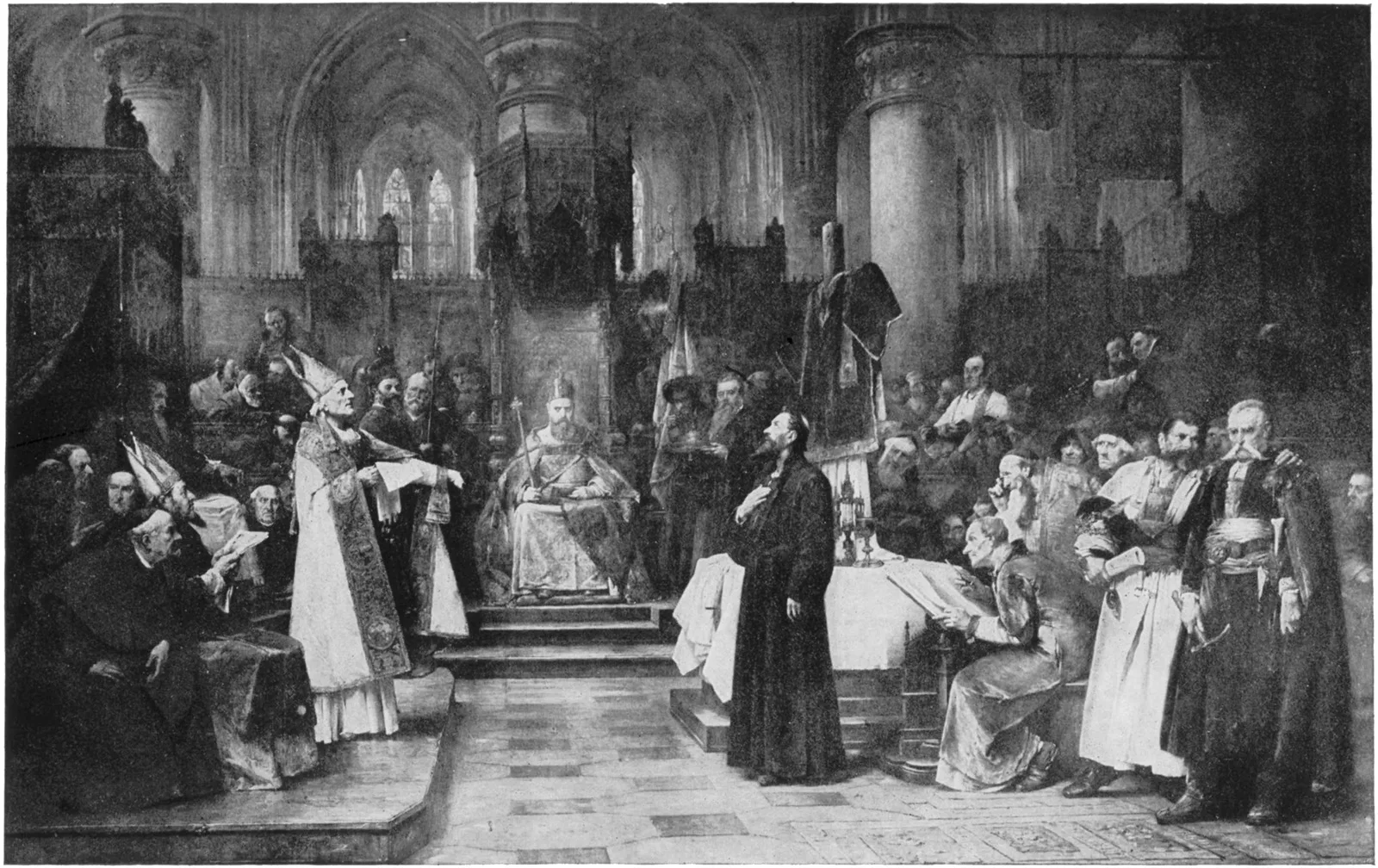
Most tellings of the Reformation start in 1517 with a monk and a church door. The fight was older than that. By the time Luther wrote his theses, men had been burning for the same convictions for more than a hundred years. Three of them are on shirts in our Reformation collection, and this section tells their stories in full. This page tells the story they share: how one Oxford professor's ideas reached Bohemia, how the church and the crown built the machinery to burn people for holding them, and what came out of the fire.
An English professor and a Czech queen
John Wycliffe taught at Oxford and died in his parish at Lutterworth on December 31, 1384. He held that Scripture was the highest authority for the church, that the pope could err, and that the bread in Communion did not stop being bread. His followers produced the first complete English Bible in the 1380s and 1390s. The church in England called those followers Lollards and spent the next century hunting them.
Wycliffe's ideas would have stayed an English problem if not for a wedding. In January 1382 Richard II of England married Anne of Bohemia, daughter of the emperor Charles IV. The marriage opened a road between Oxford and Prague. Czech students went to Oxford and came home with manuscripts. Around 1400 a young Prague scholar named Jerome of Prague sat in Oxford and copied out Wycliffe's Dialogus and Trialogus by hand and carried the copies back to Bohemia. Jan Hus, preaching in Czech at Prague's Bethlehem Chapel, read them.
The road ran both ways. In September 1410 an English Lollard priest, Richard Wyche, wrote from London to Hus to encourage him. Hus wrote back that he had read the letter aloud while preaching to a crowd he guessed at nearly ten thousand, and told them to see what care for their salvation was shown by a brother in England. His reply opens: "The Church of Christ in Bohemia greets the Church of Christ in England." A few years later an Oxford scholar named Peter Payne fled England for Bohemia, became a leading Hussite theologian, argued the Hussite case before the Council of Basel in 1433, and died in Prague in 1455. Wyche stayed in England and was burned at Tower Hill in 1440.
How burning became the law
The church did not burn anyone with its own hands. A church court tried a man for heresy, convicted him, and "relaxed" him to the secular arm. The king's officers built the fire. That is why every story on this site involves both a bishop and a prince.
In England the crown made that hand-off law in 1401. The statute De heretico comburendo, "on the burning of a heretic," ordered sheriffs to burn convicted heretics who refused to recant. A priest named William Sawtrey was burned at Smithfield in March 1401, days before the statute was formally enacted. He was the first. The second was a tradesman from Evesham named John Badby, burned at Smithfield in March 1410. He was the first layman burned for heresy in England, and his story is told in full on his own page.
On the Continent the same hand-off ran through a church council. In 1414 a council met at Constance, on the shore of Lake Constance, to end a scandal: three men each claimed to be pope. The council deposed one, accepted the resignation of the second, deposed the third, and in 1417 elected Martin V. That is what Constance is remembered for in most church histories. Between those sessions it also tried and burned Jan Hus on July 6, 1415, and his friend Jerome of Prague on May 30, 1416.
The council did one more thing. On May 4, 1415 it condemned Wycliffe, dead for thirty years, ordered his books burned, and ordered his body dug out of consecrated ground. In 1428 Richard Fleming, Bishop of Lincoln, carried the order out. Wycliffe's bones were exhumed, burned, and the ashes thrown into the River Swift at Lutterworth. Hus's ashes had already gone into the Rhine. In both cases the point was the same: leave nothing behind.
What the fire did
It did not do what the council intended.
Within two months of Hus's death, 452 Bohemian and Moravian nobles sealed a letter of protest to the council. One copy survives, at the University of Edinburgh. In Prague, Hus's friend Jakoubek of Stříbro had begun in the autumn of 1414 to give the Communion cup to lay people, and Hus had approved from prison. The council forbade the practice in June 1415. The chalice became the emblem of the Hussite movement. On July 30, 1419 a Hussite crowd in Prague threw the town councillors from the windows of the New Town Hall, and the Hussite Wars began. Five crusades were preached against Bohemia between 1420 and 1431. All five were beaten back. The church settled with the moderate Hussites at Basel in 1436 and conceded the cup. In 1457 a smaller group founded the Unity of the Brethren, which still exists as the Moravian Church.
Then came Luther. At Leipzig in 1519 Johann Eck accused him of holding Hus's errors. Luther, who had thought Hus a heretic, went back and read him. In February 1520 he wrote to his friend Spalatin: "We are all Hussites without knowing it." Later in life he had Hus's prison letters printed and wrote a preface for them.
One legend needs to be set straight. Hus is said to have told his executioners that they were roasting a goose, since "hus" is Czech for goose, but a swan would come in a hundred years whom they could not roast. There is no record of him saying it. What he did write, in a letter of October 1412, is that the Goose, "a tame creature and a domestic fowl with no power to reach great heights in his flight," had broken through the nets set for him, and that "other birds, which by God's word and by their lives soar to high places, will break their traps in pieces." The swan is Luther's addition. In 1531 he wrote that Hus had prophesied of him. Luther took the swan as his emblem, and it has stood for him since.
Three men, three pages
Hus, Jerome, and Badby were not a movement. Badby never met the other two and probably never heard their names. What they shared was a conviction that the church answers to Scripture, and a refusal to say otherwise to save their lives. Read each man on his own page.
- Jan Hus: the goose of Bohemia. A priest, a chapel that held three thousand, a paper crown painted with devils, and the Rhine.
- Jerome of Prague: what a papal secretary saw. A layman who had argued in five universities, a year in chains, a recantation, and the day he took it back.
- John Badby: the tailor in the barrel. A working man from Evesham, a court of bishops and lords, and a prince on horseback offering him his life.
All three are in the Reformation collection, alongside the men who finished what they started.