John Badby: the tailor in the barrel
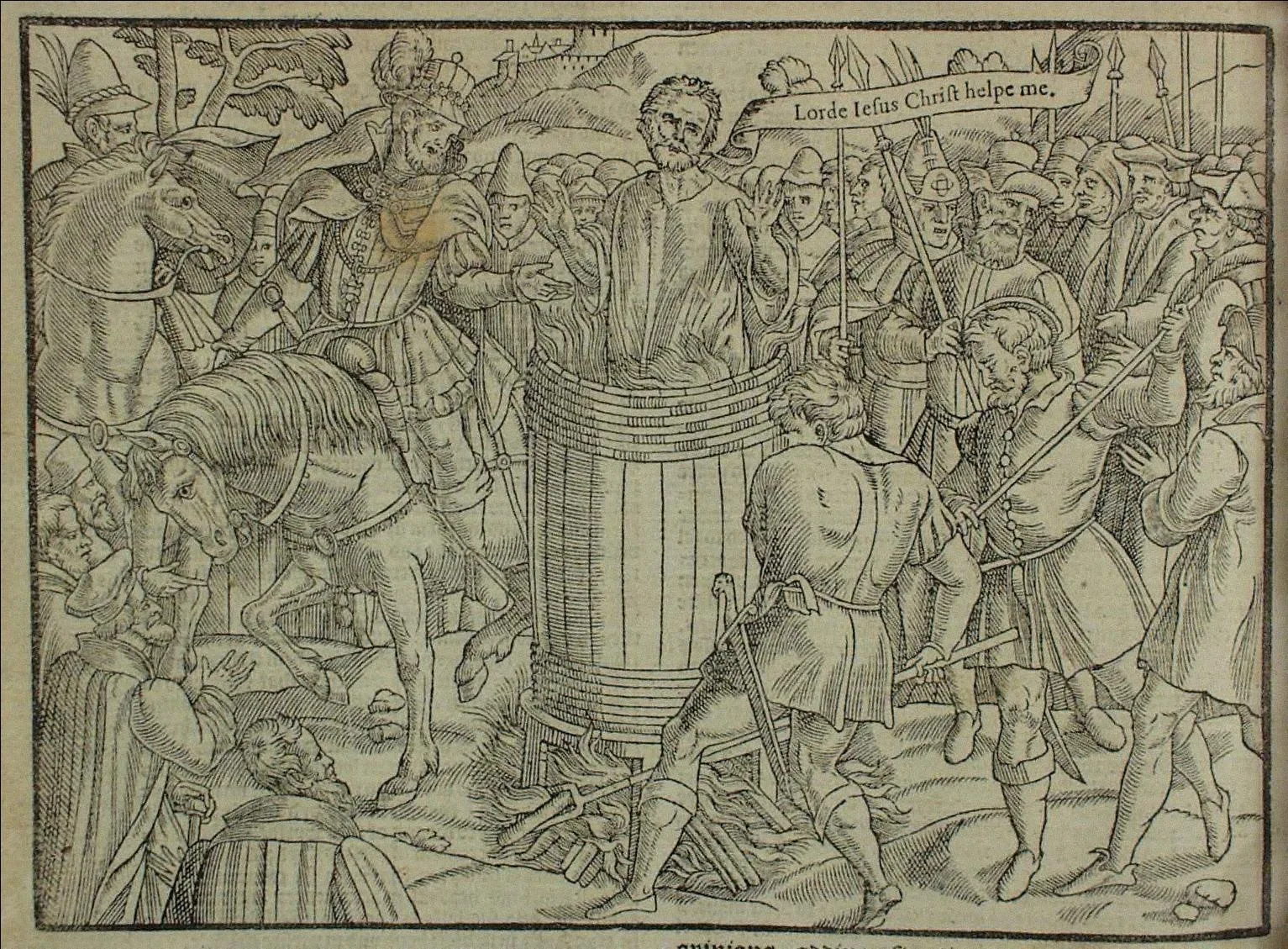
John Badby has no letters, no books, and no friend who wrote down his last words. What we know of him comes from the men who condemned him and the chronicler who approved of it. It is still enough to see him clearly.
A tradesman from Evesham
He was a tailor, or by some accounts a blacksmith, from Evesham in Worcestershire, born around 1380. He belonged to no university and held no office. He was a Lollard, one of the people the church in England had spent a generation hunting for holding what Wycliffe taught, and by 1409 he had been holding it out loud.
England had the law ready for him. In 1401 Parliament had passed the statute De heretico comburendo, which ordered the burning of convicted heretics who refused to recant. A priest named William Sawtrey had been burned under it at Smithfield that same March. Nine years later, Badby would be the second, and the first layman.
Worcester, January 1409
On January 2, 1409 Badby was examined at Worcester by Thomas Peverell, the bishop of the diocese. The charge was his view of the sacrament. The church taught that at the priest's words the bread on the altar became in substance the body of Christ. Badby said it stayed bread.
He did not say it timidly. The record of the examination has him arguing that when Christ sat at supper with his disciples he did not have his own body in his hand to distribute. He said that if every host consecrated at every altar were the Lord's body, there would be twenty thousand gods in England. He said the host was less worthy of honor than a toad or a spider, which at least were alive. The Worcester court condemned him. He was held for a year and given the chance to recant. He refused.
St Paul's, March 1410
The case went up to the Archbishop of Canterbury, Thomas Arundel, who had spent his career fighting Lollardy. Two years earlier he had issued constitutions that banned any English translation of Scripture made without a bishop's approval. On March 1, 1410 Badby was brought before him at St Paul's in London.
Arundel did not hear the case alone. He sat with a bench of bishops and with lay lords, among them his own brother-in-law. Parliament was sitting in London that season, and it had before it a petition to strip the church of its lands. A tailor who denied the sacrament was a chance to show the kingdom what the church and the crown did with heresy. Badby was condemned and handed to the secular arm.
Smithfield
He was taken to Smithfield, the open ground outside the city wall where Sawtrey had died. The chronicler Thomas Walsingham, a monk of St Albans, describes what happened next, and John Foxe printed a woodcut of it in 1563 with the note that it was drawn "in such manner as it was done."
Badby was put in an empty barrel, chained to a stake, and stacked around with dry wood. The Prior of St Bartholomew's, whose church stood at the edge of the ground, came in procession with twelve torches carried before him and the consecrated host in his hands, and asked Badby what it was. Badby said it was hallowed bread, and not God's body.
Henry, Prince of Wales, was there on horseback. He was twenty-three and would be king in three years. He urged Badby to recant. Badby would not. The fire was lit. When the flames reached him he cried out, and the prince, taking the cry for a change of mind, had the fire pulled away and the barrel opened, and offered him his life and a pension if he would conform.
Badby refused. The wood was pushed back and lit again, and he died in it.
Most sources give the date as March 1, 1410, the day of the hearing. A few give March 5. Either way the church court, the sentence, and the fire fell within the same week.
A working man
The men on the other pages of this section were scholars. They had Latin, degrees, and friends who wrote their deaths down. Badby had a trade and an argument, and he made the argument to a bishop, to an archbishop, to a bench of lords, and to the heir to the throne, with the fire already lit, and did not change it. Prince Henry could offer him his life and a pension. He could not offer him a reason to say the bread was anything but bread.
Three years after Badby died, Henry became king. The Lollard rising he put down in 1414 and the hunt that followed drove the movement underground for a century. It came up again with Tyndale's Bible. The general story is on the forerunners page.
The shirt

Our John Badby tee shows the barrel, the prince on his horse, and the prior with the host. Those three details come from Walsingham and from the 1563 woodcut. The composition is a modern illustration, and the words on it are ours.