Jerome of Prague: what a papal secretary saw
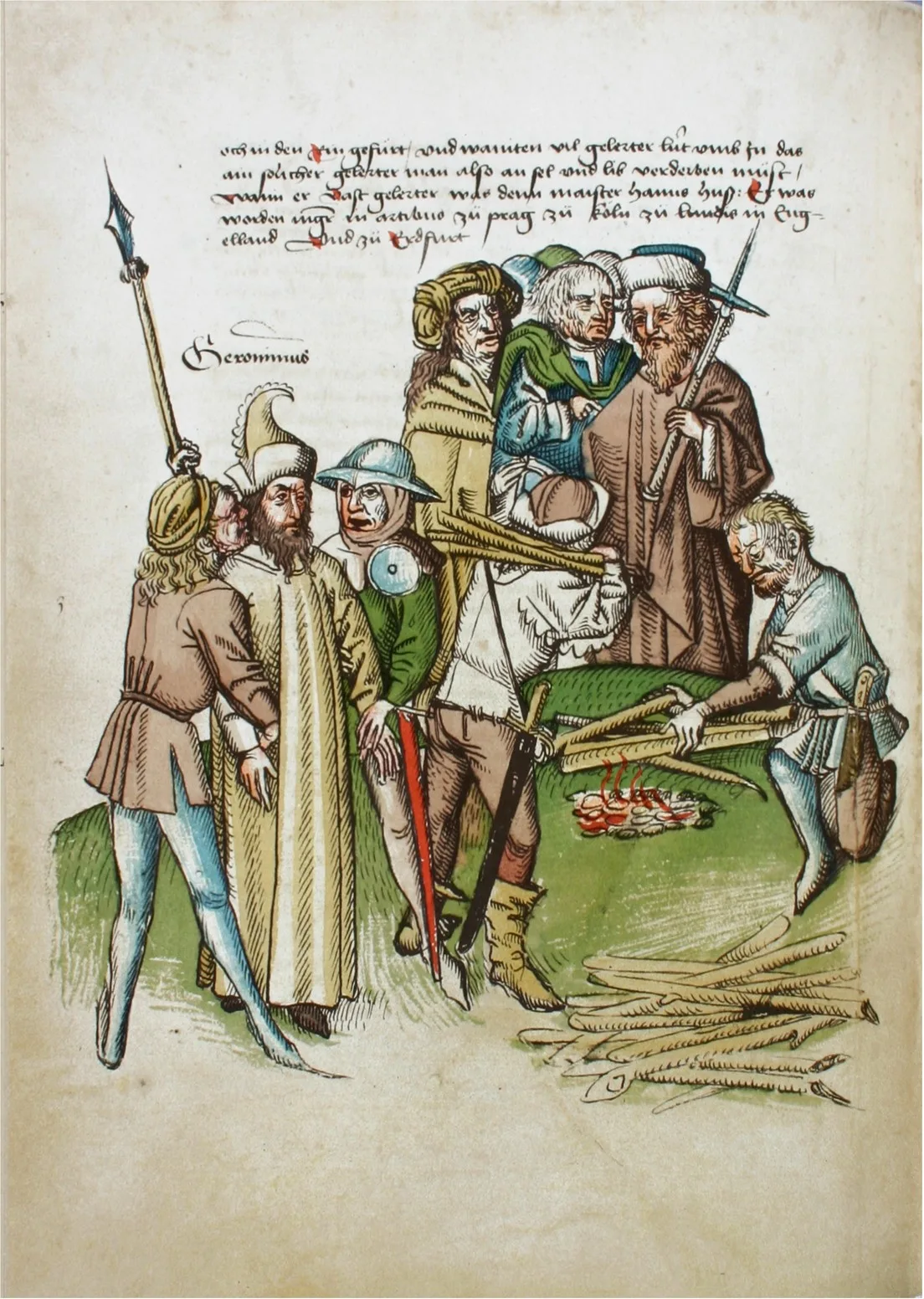
The best account of Jerome of Prague's death was written by a man who worked for the pope. Poggio Bracciolini was a papal secretary and one of the great Latin scholars of his age. He sat through Jerome's last hearing and stood in the crowd at the fire, and that evening he wrote to his friend Leonardo Bruni in Florence. He did not agree with Jerome. He could not stop admiring him.
A layman in five universities
Jerome was born in Prague around 1379, a few years after Hus, and took his first degree at the University of Prague in 1398. He never became a priest. He was a master of arts, a debater, and a traveler, and he was better known across Europe than Hus was.
Around 1400 he was at Oxford, where he copied out two of Wycliffe's books by hand and took the copies home to Prague. In 1403 he went on pilgrimage to Jerusalem. He then took master's degrees at Paris, Cologne, and Heidelberg, and Prague recognized them in 1407. At Paris he defended Wycliffe's philosophy and clashed with Jean Gerson, the university's chancellor. Gerson would sit among his judges at Constance. In 1410 he preached against clerical corruption at Buda, before King Sigismund, was arrested in Vienna, and escaped to Moravia. In Poland and Lithuania he traveled with the Lithuanian grand duke and attended Orthodox services, which the council would later hold against him.
In Prague he stood beside Hus at every turn: the university fight of 1409, and the indulgence protests of 1412, where the older accounts say his speech did more than Hus's to move the crowd.
Constance
Jerome had no safe conduct and no summons. He went anyway. He reached Constance on April 4, 1415, while Hus was in chains at Gottlieben, and on April 7 he had notices posted asking the council for a safe conduct and a hearing. The council offered a safe conduct that would protect him from violence but not from its own justice. He left. On April 20 he was recognized and arrested at Hirschau in Bavaria, and on May 23 he was brought back to Constance in irons.
Poggio describes what came next. For 340 days he lay in the bottom of a foul, dark tower, shackled, in squalor and filth. Hus was burned on July 6. On September 11 and again on September 23, 1415, Jerome recanted. He condemned Wycliffe's articles and Hus's, and put his name to Hus's condemnation. In a letter of August that year he had already called Hus a man who had written many false and harmful things.
It was not enough. His accusers, the same two Czech priests who had built the case against Hus, called the recantation ambiguous and brought new charges. Jerome sat in the tower through the winter.
May 26, 1416
He was given a public hearing on May 23 and again on May 26. Poggio, who was there, says the council expected him to confirm his recantation and be done. Instead he stood up and withdrew it.
Poggio's letter records the speech. Jerome said he had sinned in only one thing: in consenting to the condemnation of Hus, whom he now called a good man, just and holy, unworthy of such a death. He said the recantation had been forced from him by fear of the fire. He asserted that he had not erred. He answered the council's charges one by one, from memory, after a year without a book. Poggio writes that his voice was full, clear, and soft, his bearing that of an orator, and that he stood there fearless, not despising death so much as seeking it, so that you would have said he was another Cato. He told the council that they could hardly deny that a layman kept 340 days in a dark tower had earned the right to speak.
The council condemned him on May 30, 1416 and burned him the same day, on the meadow where Hus had been burned ten months earlier. He wore a paper crown painted with red devils. The chronicler Ulrich Richental, a citizen of Constance who watched both burnings and had no sympathy for either man, describes Jerome as a big, strong man with a thick black beard grown long in prison. When the executioner went to light the pile behind him, out of his sight, Jerome told him to come round and light it in front: had he been afraid of it, he would never have come to this place. Poggio says he began to sing as the fire caught, and that the smoke and flame scarcely interrupted him. His ashes went into the Rhine after Hus's.
The layman
Jerome was never ordained. He held no office. He had no congregation and no city that would protest his death. What he had was the training to argue and the memory to do it without notes, and on the last day he used both to reverse the only thing he had said under duress. The man who wrote the account of it wanted him convicted and could not make himself write anything but praise.
His name is on the other face of the memorial boulder at Constance. The general story of what came after both deaths is on the forerunners page.
The shirt

Our Jerome of Prague tee shows him at the stake, bare to the waist, with the beard Richental described and soldiers and clergy around the pile. It is a modern illustration, not a copy of any period image. The words are ours.