Jan Hus: the goose of Bohemia
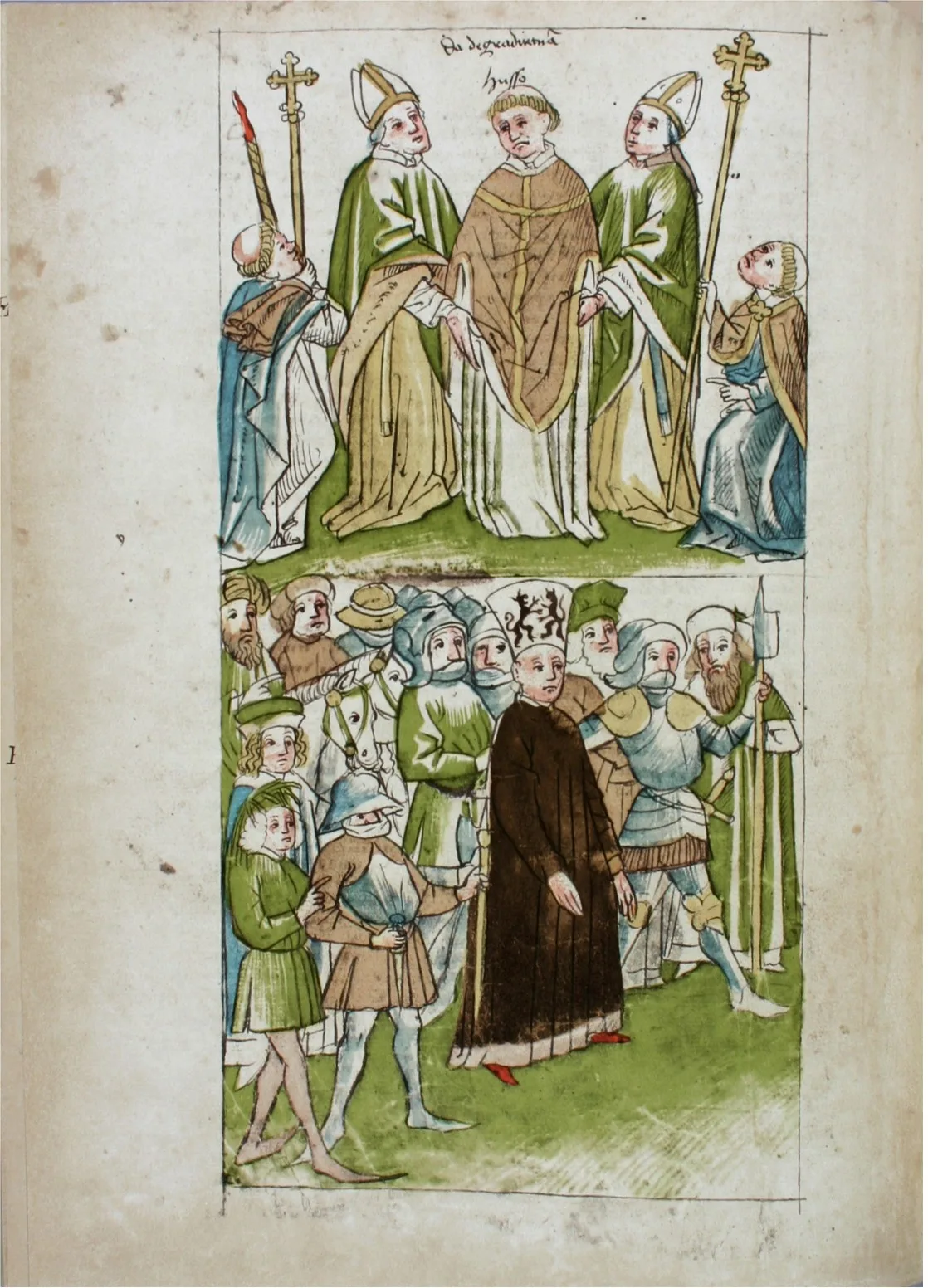
His name means goose. His friends called him that, and he signed letters with it. When his enemies set what he called their nets for him, he wrote that the Goose was a slow domestic bird with no gift for heights, and had broken through anyway. The joke lasted longer than the man. What follows is the record of how he lived and how he died, most of it from a friend who stood in the crowd at Constance and wrote down what he saw.
The chapel
Jan Hus was born around 1370 in Husinec, a village in southern Bohemia. He studied at the University of Prague, took his master's degree in 1396, and was ordained a priest in 1400. In 1402 he was appointed preacher at the Bethlehem Chapel in Prague's Old Town.
The chapel matters. It had been founded in 1391 for one purpose, preaching in Czech rather than Latin, and it could hold about three thousand people. Hus filled it. He preached in the language of the people who came, and he wrote in it too. The oldest system of Czech spelling with accent marks, the one still used today, is traditionally credited to him, though scholars are not certain he wrote the treatise that describes it.
Wycliffe's books had reached Prague, some of them copied out at Oxford by Hus's friend Jerome. Hus did not accept everything in them, but he took the core: the church answers to Christ and to Scripture, and a pope or a priest who lives against the gospel has no claim on a Christian's obedience. He said so from the pulpit, to thousands, week after week.
The nets
In 1409 the king reorganized the university's voting so that the Bohemian masters outvoted the German ones. The German masters walked out and founded a new university at Leipzig. Hus was elected rector of what remained. In the summer of 1410 the archbishop of Prague had Wycliffe's books burned in his courtyard and excommunicated Hus.
In 1412 a papal agent arrived selling indulgences to fund a war between the pope, John XXIII, and the King of Naples. Hus preached against the sale. Three young men who heckled the indulgence preachers were arrested and beheaded. Hus's followers carried their bodies to the Bethlehem Chapel. The pope answered with a harsher excommunication and put Prague under interdict, which meant no sacraments in the city as long as Hus stayed. Hus left rather than let the city be punished for him. From the countryside he wrote his major Latin work, On the Church, and a set of Czech works for people who could not read Latin. In one of those, an exposition of the Creed, he wrote the sentence that is carved on his memorial in Prague: seek the truth, hear the truth, learn the truth, love the truth, speak the truth, hold the truth, defend the truth until death.
Constance
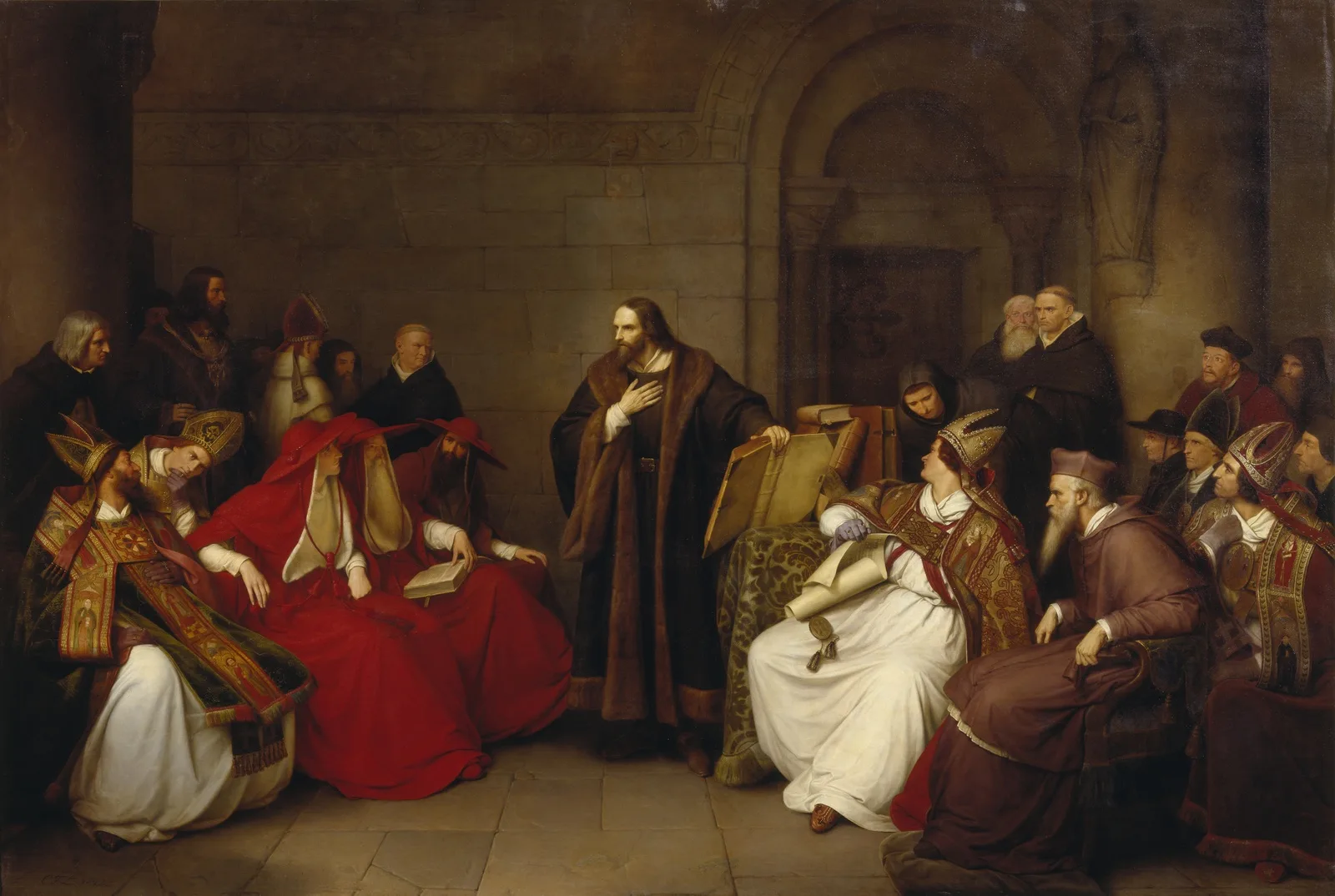
In 1414 a council gathered at Constance to end the scandal of three rival popes. Sigismund, King of the Romans and heir to the Bohemian throne, invited Hus to come and clear his name, and gave him a written safe conduct. Hus left Prague on October 11, 1414 and reached Constance on November 3. On November 28 he was arrested and locked in a cell in the Dominican monastery by the lake, where he fell ill.
The safe conduct did not help him. The council's position was that a promise to a heretic did not bind. Peter of Mladoňovice, a Czech scholar who had traveled with Hus and who wrote the eyewitness account most of this page rests on, says that when Hus reminded the king of the safe conduct to his face at the hearing of June 7, 1415, Sigismund went red. Some historians doubt the blush. No one doubts the arrest.
In March 1415 Pope John XXIII, who had been holding Hus, fled Constance in disguise. The council deposed him on May 29. On the night of March 24 the Bishop of Constance had Hus moved by boat to his castle at Gottlieben on the Rhine. There he spent seventy-three days, fettered by the legs in the day and chained by the hands at night. The deposed pope was later held in the same castle.
Hus was given three public hearings, on June 5, 7, and 8. Peter records shouting from the benches to drown him out, and laughter when he spoke. Hus said the same thing each time: he had not come to defend errors obstinately, and he would recant anything shown to him from Scripture to be wrong. The council's answer was that the articles had been decided and his part was to submit. He would not swear to have taught things he had not taught. He said he feared to do so "lest I be believed a liar."
July 6, 1415
The sentence was read in the cathedral. Hus was dressed in a priest's vestments and then stripped of them piece by piece. The chalice was taken from his hands. Then a tall paper crown was set on his head, painted with three devils and lettered with the word Heresiarch. Peter says that Hus looked at it and said his Lord had worn a crown of thorns for him, and he would wear this one for his Lord. The bishops pronounced that they committed his soul to the devils. Hus answered that he committed it to the most merciful Lord Jesus Christ.
He was handed to Ludwig, Count Palatine of the Rhine, with the order to burn him. The procession passed through the churchyard, where his books were already burning, and out of the city to a meadow. He was tied to a stake with a rusty chain and wood and straw were heaped around him to the chin. The marshal asked once more whether he would recant and save his life. He said that God was his witness that he had never preached the things charged against him, and that he was willing to die gladly in the truth of the gospel he had written, taught, and preached.
When the fire was lit he began to sing, in Latin: Christ, Son of the living God, have mercy on me. He sang it through twice. On the third time the wind turned the flames into his face and he stopped. Peter says his lips went on moving for the space of two or three Our Fathers.
The executioners broke up what was left, found the heart and burned it on a stake, burned his coat and shoes so no one could carry away a relic, and loaded the ashes into a cart and tipped them into the Rhine.
After
Within two months 452 Bohemian and Moravian nobles had sealed a protest to the council. Within five years Bohemia was at war with the rest of Christendom and winning. The general story of what followed, and how Luther came to say "we are all Hussites," is told on the forerunners page.
July 6 is a public holiday in the Czech Republic. A boulder stands on the meadow at Constance where he was burned, placed there in 1862, with Jerome's name on the other side. In 1999 Pope John Paul II expressed deep regret for the cruel death inflicted on Hus. The council's own decision has never been reversed.
The shirt

Our Jan Hus tee puts him at the stake in the tall paper crown, with a swan over the smoke. The swan is the legend, not the record: Luther's later reading of the goose letters, told in the forerunners page. The rest of the scene follows what Peter of Mladoňovice described. The picture is a modern illustration. The words on it are ours.