
Martin Luther
Under Load, Still Standing
$35
Premium 100 percent combed ring-spun cotton, preshrunk
Martin Luther shoulders a loaded barbell over the words Under Load, Still Standing, on the back. The Patriarch Outfitters mark sits upper left chest, and the sleeve carries a Nehemiah 4:14 cross cut through to the shirt color. The illustration draws on Luther's disguise as Junker Jorg at Wartburg Castle. Printed to order on a premium tee of preshrunk 100 percent combed ring-spun cotton in a fitted cut, with a Patriarch Outfitters label inside the neck that lists the size, country of origin, and material.
Larger sizes cost a little more to make.
Made to order and ready in 2 to 5 business days, then 3 to 7 in transit. Flat-rate US shipping of $6 per order is added at checkout.
Details
- Fabric
- Premium 100 percent combed ring-spun cotton, preshrunk
- Fit
- Fitted cut
- Construction
- Side-seamed
- Shrinkage
- Preshrunk fabric that can still shrink slightly
- Printed to order in one ink
- Sleeve
- Right sleeve print
- Label
- Patriarch label inside the neck with the size, country of origin, and material
- Care
- Wash cold inside out, tumble dry low or hang dry, do not iron the print. Hot water can shrink the fabric.
- Placement
- Back, Front, Neckline detail and Sleeve
Front and back
-

Front -

Back
The story
Martin Luther (1483-1546) was a German monk, pastor, and university professor who became a central figure in the Protestant Reformation. In 1517, his Ninety-Five Theses challenged the sale and preaching of indulgences. The dispute grew into a movement that reshaped Christianity and led to the formation of Protestant churches.
Luther taught that salvation is God's gift, received through faith in Jesus Christ rather than earned through good works. He held Scripture as the authority for Christian teaching. His preaching, writing, and Bible translation carried those convictions beyond the university and into ordinary households.
Who was Junker Jörg?
Junker Jörg was Luther's concealed identity during his stay at Wartburg Castle in 1521 and 1522.
In April 1521, Luther appeared before Emperor Charles V at the Diet of Worms, an imperial assembly. Ordered to withdraw his teachings, he refused unless convinced that they were wrong by Scripture and sound reasoning. On his journey home, men acting under the protection of Frederick the Wise staged an abduction and took him to Wartburg Castle for his safety.
There, Luther grew his hair and beard and adopted the appearance of a nobleman. This is the bearded likeness associated with Junker Jörg, preserved in Lucas Cranach the Elder's portraits and woodcuts. It looks markedly different from the familiar image of Luther in a scholar's cap.
His work continued in hiding. At Wartburg, Luther translated the New Testament from Greek into German. After revision with fellow scholars, it was published in September 1522, helping more German-speaking readers encounter Scripture in their own language.
Under load. Still standing.
This design draws its historical inspiration from Cranach's 1522 woodcut of Luther as Junker Jörg.
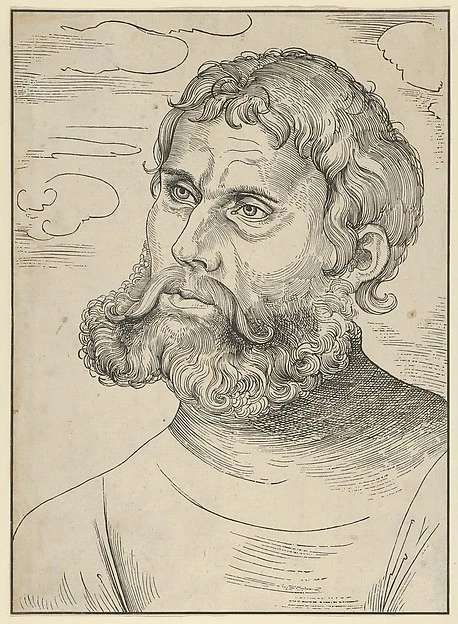
The New Testament he translated at the Wartburg was printed in Wittenberg on three presses, three thousand copies, with no translator's name on the title page. What the press did with Luther's argument.
The barbell scene is a modern illustration, not a historical event. "Under load. Still standing." is original Patriarch Outfitters wording, not a Luther quotation. The design honors conviction, disciplined effort, and the resolve to continue working under pressure.


